antimicrobials-mercury-saferalternatives.org
  • Home
  • Mercury
  • Antimicrobials
  • About
  • More
    • Home
    • Mercury
    • Antimicrobials
    • About

  • Home
  • Mercury
  • Antimicrobials
  • About

How are people TYPICALLY exposed to mercury?

In the United States, the most common exposure is methylmercury from eating fish and shellfish. Other exposures can occur through certain products, especially when they break or are used improperly.  


Mercury occurs in different forms, including elemental (metallic), inorganic, and organic mercury such as methylmercury. These forms do not behave identically in the body, so exposure advice depends on the form and route of exposure.


Fish and shellfish

Skin-lightening products

Fish and shellfish

Methylmercury can build up in fish. The amount varies by species, so choosing a variety of fish and following official advice matters.

Broken products

Skin-lightening products

Fish and shellfish

Some older thermometers, thermostats, switches, fluorescent bulbs, and laboratory equipment contain mercury. When released, metallic mercury can evaporate into an invisible, odorless vapor.

Skin-lightening products

Skin-lightening products

Skin-lightening products

Some skin-lightening and anti-aging products have been found to contain mercury. Avoid products without a complete label and check official warnings.

Products that may contain mercury

Skin-lightening and anti-aging products


Mercury has been found in some skin-lightening and anti-aging creams, including products marketed for age spots, freckles, blemishes, wrinkles, or acne. Check the label for terms such as mercurous chloride, calomel, mercuric, mercurio, or mercury. If one appears, stop using the product. Do not use a product that has no ingredient label.

  • FDA warning: Skin products containing mercury and/or hydroquinone
  • California Department of Public Health: Skin-care products tested for mercury
  • Amazon to block sales of skin lightening creams containing mercury in response to lawsuit under Proposition 65’s Toxic Enforcement Act


Thermometers, thermostats, switches, and fluorescent bulbs

Some older fever, oven, candy, and meat thermometers, thermostats, barometers, switches, and fluorescent bulbs contain mercury. Older laboratory equipment and some older appliances or electronics may also contain mercury. Certain older vehicles (particularly some models made before 2003) used mercury switches in convenience lighting or other systems. Use mercury-free alternatives when replacing items; do not break or dismantle a mercury-containing product. Choose LEDs when replacing fluorescent or CFL bulbs, and use digital mercury-free thermometers.

  • EPA: List of common consumer products that contain mercury
  • EPA: Mercury thermometers and alternatives
  • EPA: Broken CFL cleanup guidance


Medicines, vaccines, and contact lens products

Some mercury compounds have been used as preservatives in certain medicines and biological products, but many historical uses have been discontinued. Do not assume a medicine, nasal spray, vaccine, or contact lens solution contains mercury based on the product category or an old list. Check the exact current package insert or ingredient label.

  • FDA: Mercury in drug and biologic products (historical product listings; not a current shelf inventory)
  • Johns Hopkins Institute for Vaccine Safety: Vaccine components and excipients
  • Peer-reviewed review: Preservatives in soft contact lens care products (includes historical products; check current labels)


Older light-up shoes

Certain L.A. Gear light-up shoe models sold before June 1994 used a mercury tilt switch in the heel. This is a documented historical issue and is not evidence that modern light-up shoes contain mercury. If you have an old pair, do not dismantle the heel; ask your local household hazardous-waste program how to handle it.


Older polyurethane gymnasium floors

Some older poured polyurethane gym floors used phenylmercuric acetate (PMA) as a catalyst. Not all rubber-like or polyurethane floors contain mercury. Schools and facility owners should check the floor's history and consult qualified environmental professionals about testing before sanding, grinding, resurfacing, or otherwise disturbing a suspect floor.

  • ATSDR health consultation: Mercury-containing polyurethane gym floor
  • Howard County Public School System: Mercury testing in poured rubber flooring
  • Virginia Tech research: Mercury emissions from polyurethane gym floors


Older jewelry, antiques, batteries, and specialty items

Some novelty jewelry has historically used sealed glass pendants containing liquid mercury. Older barometers, clocks, mirrors, gauges, and laboratory items may also contain mercury. Some older button-cell batteries contained mercury, although many products have changed and the presence of mercury depends on the item and date of manufacture. Do not dismantle unfamiliar items to check. Ask a household hazardous-waste program or qualified recycler how to handle them.

For a product-specific list, see the EPA list of common consumer products that contain mercury.


Dental amalgam (“silver” fillings)

Dental amalgam contains elemental mercury combined with a powder of other metals. If you have questions about your own dental fillings, discuss them with a qualified dental professional rather than attempting to remove or disturb a filling yourself.

EPA: Dental amalgam fillings


Health effects depend on the type and amount of exposure

Methylmercury (in fish and other foods)

Methylmercury is the organic form of mercury that builds up in fish and other foods. It enters the food chain and is easily absorbed by the body. Exposure is most often through fish and shellfish. Possible effects at harmful exposure levels include impaired coordination, changes in sensation, and problems with vision, hearing, speech, or muscle strength.

Elemental mercury vapor (from liquid mercury)

Elemental mercury is a shiny, liquid metal. It can turn into a vapor at room temperature. Breathing vapor from spilled mercury is a key concern. Symptoms from significant or prolonged exposure can include tremors, mood or sleep changes, headaches, muscle weakness, and changes in sensation or mental performance. Severe exposure can cause serious lung and kidney effects.

Inorganic mercury compounds (mercury salts)

Inorganic mercury compounds (mercury salts)

Inorganic mercury compounds are solid or liquid forms, such as mercury salts. They are often used in industrial products and can be harmful if released or ingested. High exposures can harm the digestive tract, nervous system, and kidneys. Effects differ by compound and exposure route.

Mercury in fish

Making Informed Choices


Fish can be part of a healthy diet. The goal is not to avoid all fish, but to choose a variety and follow current advice for the people eating it—especially people who are pregnant or may become pregnant, breastfeeding people, and children.


FDA/EPA guidance categorizes fish by mercury levels. 

Best choices (lower mercury) Salmon · Sardines · Shrimp · Tilapia · Trout · Pollock · Catfish · Canned light tuna


In the FDA/EPA advice cited here, canned light tuna is a “Best Choices” option, while albacore (white) tuna is a “Good Choices” option and typically contains about three times as much mercury as canned light tuna. 


Recommendations and serving guidance can change, so consult the current official chart for weekly serving limits.
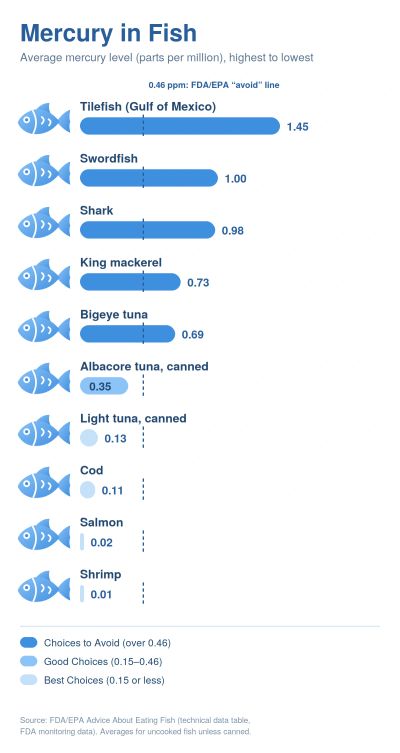
  • FDA/EPA advice about eating fish for people who are or might become pregnant
  • California OEHHA: Fish advisories
  • EPA Advice - Choose Fish and Shellfish Wisely

These symptoms are not specific to mercury and cannot diagnose mercury poisoning. If you think you or someone else has been exposed, contact a healthcare professional or Poison Control for case-specific advice.

  • EPA: Health effects and exposures
  • CDC/ATSDR: Mercury toxic substance information
  • ATSDR ToxGuide: Mercury

Possible Exposure

Poison Control 1-800-222-1222(24/7). Medical emergency: call 911. 

What you can do

  • Choose mercury-free alternatives when replacing thermometers, thermostats, and light bulbs (LEDs instead of CFLs or fluorescent tubes).
  • Follow current FDA/EPA and California OEHHA fish advice, especially for pregnancy, breastfeeding, and young children.
  • Never vacuum or sweep spilled mercury; use official EPA cleanup steps.
  • Check labels on skin-lightening and anti-aging products; avoid products without ingredient lists.
  • Dispose of mercury-containing items only through household hazardous-waste programs—never in regular trash or drains.
  • For schools and facilities: verify the history of older polyurethane gym floors before any sanding or resurfacing work.

⚠ If mercury spills or a mercury-containing item breaks

Do not vacuum or sweep mercury. These actions can spread mercury and increase exposure to its vapor.

  • Keep children and pets away from the spill. Do not touch or play with the mercury.
  • Do not pour mercury down a drain or put it in household trash.
  • Open windows and doors to the outside if safe; close doors to other rooms.
  • Follow the official instructions for the specific situation before attempting cleanup.

Use EPA's step-by-step instructions:

  • What to do if a mercury thermometer breaks
  • What to do if a compact fluorescent lamp (CFL) breaks
  • What to do if you spill more mercury than is in a thermometer

If the spill is large, involves a school or workplace, is on carpet or upholstery, or is near an HVAC vent, keep people away and contact your local health department, fire department, or hazardous-waste program for advice before attempting cleanup. For possible exposure, call Poison Control at 1-800-222-1222 or seek medical advice.

Where to take mercury-containing products in California

Do not put mercury, mercury-containing devices, or fluorescent bulbs in regular household trash, ordinary recycling, or a drain. Disposal options depend on the item and local rules. Contact your local household hazardous-waste program before transporting a broken or leaking item. Keep intact products in their original packaging when possible; never transport loose mercury in an unsealed container.

Los Angeles City

LA Sanitation & Environment SAFE Centers

Locations and accepted materials

Information line: 1-800-773-2489

Call first to confirm accepted items, hours, and instructions.

Los Angeles County Sanitation Districts

Household hazardous-waste collection

Collection information and locations

Information line: 1-800-238-0173

Call first to confirm accepted items, hours, and instructions.

California statewide

CalRecycle household hazardous waste

Find guidance for safe household hazardous-waste disposal

Download and Share

Download PDF

Resources

  • U.S. EPA: Mercury — exposure, products, health effects, spills, and cleanup.
  • U.S. FDA — food advice, cosmetics, medicines, and product warnings.
  • CDC/ATSDR — toxicology and health information.
  • California DTSC: Mercury waste — California product and waste guidance.
  • California OEHHA — health risk assessments and environmental health guidance.
  • PubMed: Peer-reviewed mercury research.

RESPONSE TO THE PETITION OF BAYER CORPORATION FOR CLARIFICATION OF THE PROPOSITION 65 LISTING OF “MERCURY AND MERCURY COMPOUNDS” AS CHEMICALS KNOWN TO CAUSE REPRODUCTIVE TOXICITY CALIFORNIA ENVIRONMENTAL PROTECTION AGENCY OFFICE OF ENVIRONMENTAL HEALTH HAZARD ASSESSMENT 

February 2004

Page 30: "Identification of mercury compounds as a class is clear, specific and unambiguous in that any chemical compound (i.e., any substance that consists of two or more chemical elements in union) that contains mercury is so identified. PMA and thimerosal are unquestionably substances that contain mercury in union with other elements. Current U.S. EPA documents clearly and specifically identify mercury compounds as causing reproductive toxicity. OEHHA therefore finds the listing of mercury and mercury compounds encompasses thimerosal and PMA.


Full Report

Fitzstevens, M., Alex-Oni, K., Sedlar, S. et al. Mercury in skin lightening and skin care products purchased in New York City, 2009-2022. J Expo Sci Environ Epidemiol (2026). https://doi.org/10.1038/s41370-026-00961-9

"Our findings show that nearly one in three skin lightening and skin care products purchased across NYC between 2009 and 2022 contained mercury, and that despite existing regulations, one in five exceeded the U.S. FDA’s permissible limit."

Study - Mercury in Skin Lightening Products

EPA Mercury Response: This website contains information related to elemental mercury response. Included is the National Elemental Mercury Response Guidebook 2019 and other material to support the On-Scene Coordinator (OSC) in responding to or conducting outreach for mercury spills and issues.

Elemental Mercury Response
  • Privacy Policy
  • Disclaimer

mercuryandantimicrobials.org

Copyright © 2026 mercuryandantimicrobials.org - All Rights Reserved.

Powered by

This website uses cookies.

We use cookies to analyze website traffic and optimize your website experience. By accepting our use of cookies, your data will be aggregated with all other user data.

DeclineAccept